
Client profile
An biopharma commercial organization designing a new incentive compensation plan for a newly approved drug. The client needed to compare alternative plan structures before launch while keeping the same field population, performance assumptions, and business rules consistent across scenarios.
Context and objectives
Incentive plan design had become a repetitive spreadsheet exercise. Every “what if” question—moving a threshold, changing an accelerator, adjusting a cap, or testing a different payout curve—created another calculation cycle. Teams then had to reconcile workbook versions, check whether assumptions had changed, and explain why one scenario differed from another.
The problem was not simply calculating payouts. The client needed to understand how plan mechanics would behave across hundreds of representatives before committing to a design. A change that looked reasonable at an aggregate level could create very different outcomes for individual representatives, territories, or the total compensation budget.
The objective was to create a controlled simulation environment where planners could test multiple plan structures against the same underlying population, compare the results quickly, identify unusual payout outcomes, and make the assumptions behind each scenario easy to review.
The solution
- Improzo translated the proposed compensation methodology into structured plan logic, including thresholds, target payouts, payout curves, accelerators, caps, eligibility rules, and defined exceptions.
- Payout calculations remained deterministic so the approved compensation methodology—not a generative model—remained authoritative.
- AI agents were used around that calculation layer to help configure scenarios, compare alternatives, summarize sensitivities, and surface unusual patterns that deserved attention.
- Because every scenario ran against the same underlying field population and assumptions, planners could isolate the effect of changing the plan itself.
- Validation checks made it easier to see whether a result was driven by a plan parameter, a data issue, or an exception requiring review. Instead of rebuilding the analysis for every new question, the team could adjust a defined parameter, rerun the simulation, and compare the outcome within the same environment.
The impact
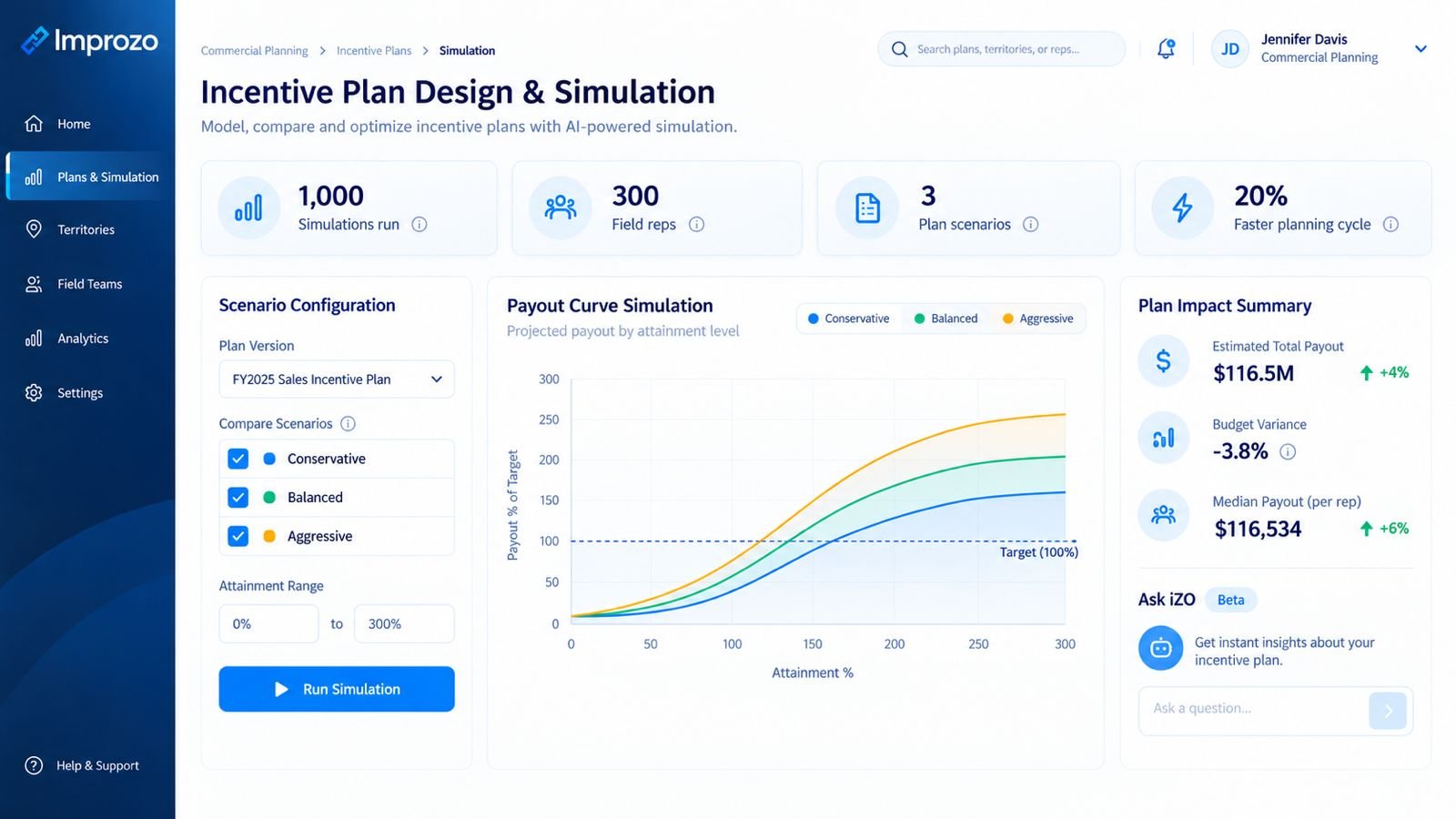
The engagement evaluated more than 1,000 payout simulations across 300+ field representatives and shortened the planning cycle by an internally estimated 20%. More importantly, the planning process became easier to interrogate. Commercial leaders could compare payout distributions and budget exposure before launch without waiting for a new spreadsheet production cycle each time.
The reusable value extended beyond one plan. The same plan-configuration, simulation, validation, and comparison patterns can be adapted for future brands, field teams, and compensation cycles. Final plan approval remained with commercial leadership; the system accelerated and clarified the decision rather than making it autonomously.